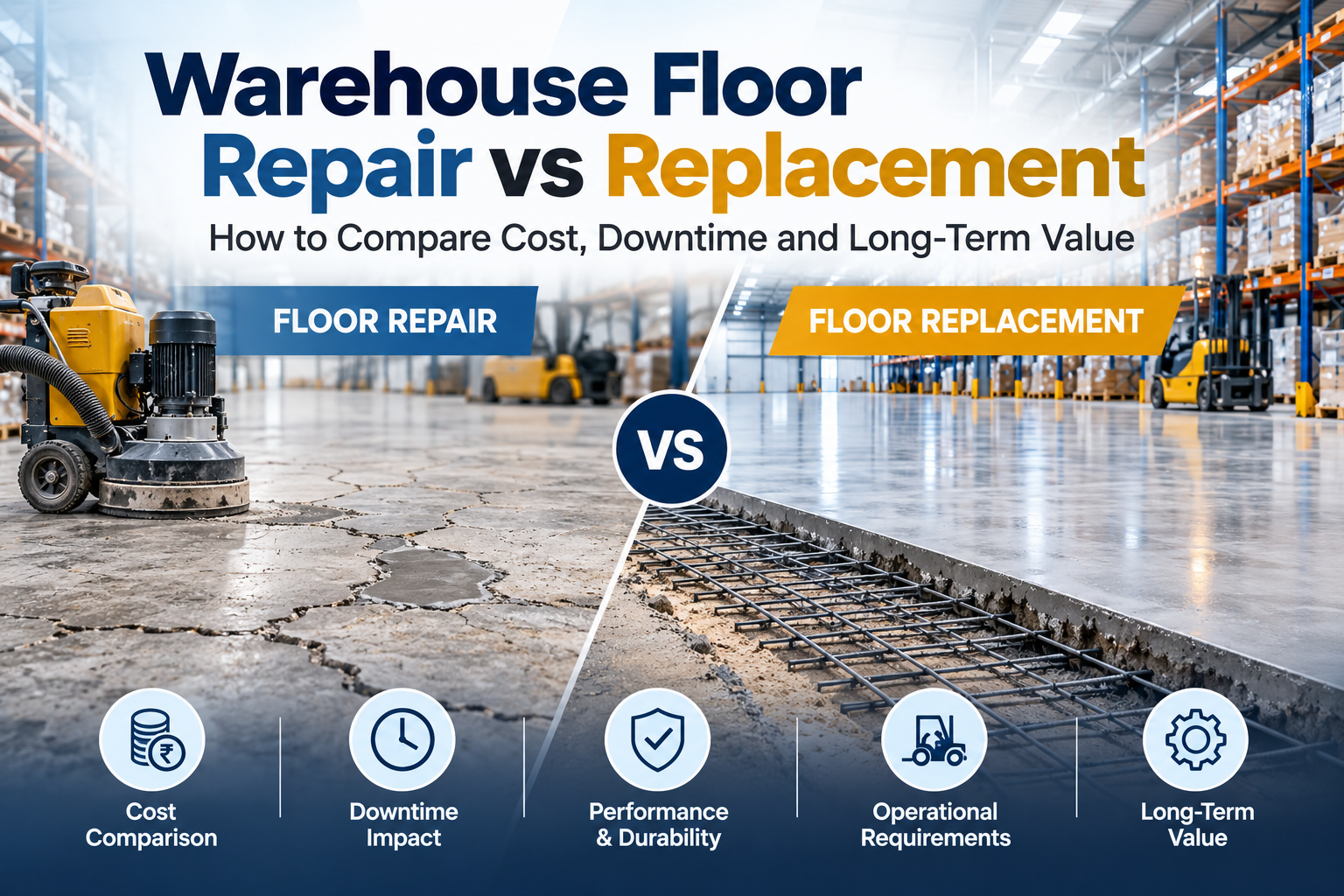
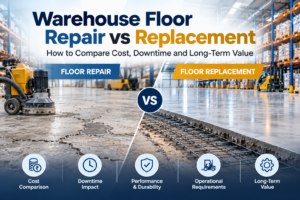
Choosing between warehouse floor repair vs replacement starts with understanding why the floor is deteriorating. Localised surface damage may be suitable for repair, while widespread deterioration, unresolved settlement or a floor that cannot support planned operations may require more extensive work.
For warehouse owners and facility managers, the decision involves more than the contractor’s quotation. Downtime, forklift movement, storage requirements, recurring maintenance and future loading needs all affect the long-term value of the investment.
This guide explains how to compare both options and what to check before requesting a proposal.
Warehouse Floor Repair vs Replacement: Which Is Better?
Repair is generally worth considering when damage is limited and the underlying slab remains suitable for its intended use. Replacement becomes a stronger option when substantial sections are unsuitable, repeated repairs have failed or operational requirements have changed.
An assessment should establish the cause, extent and significance of the damage before selecting a treatment. The American Concrete Institute emphasises identifying the underlying cause and repair objective before concrete repair begins. concrete.org
Replacement does not always mean removing the entire warehouse floor. Selective replacement of individual panels or damaged zones may provide a practical middle option.
| Decision Factor | Floor Repair | Floor Replacement |
| Typical scope | Treat specific defects or restore surfaces | Remove and reconstruct selected sections or the full slab |
| Initial expenditure | Often lower for limited damage | Often higher due to demolition and reconstruction |
| Operational disruption | May be manageable in small work zones | Usually requires larger restricted areas |
| Existing floor limitations | May remain unless specifically addressed | Can address design limitations within the agreed scope |
| Long-term value | Depends on diagnosis and repair suitability | Depends on correcting causes and designing for actual operations |
What Causes Warehouse Floor Damage?
Similar-looking defects can have different causes. A repair selected only by appearance may fail to address the actual problem.
Common issues include:
- Joint-edge damage: Chipping or spalling where forklift wheels cross joints.
- Surface wear: Dusting, abrasion or deterioration along busy routes.
- Cracking: Associated with shrinkage, restraint, movement or loading.
- Uneven panels: Potentially related to curling, settlement or loss of support.
- Coating failure: Peeling, blistering or loss of adhesion.
- Local impact damage: Damage around loading areas, equipment or handling routes.
A cracked floor does not automatically require replacement. ACI notes that completely crack-free and curl-free concrete floors are unrealistic, even with good design and construction. The important question is whether the defect affects performance and intended use. concrete.org
When Is Warehouse Floor Repair Suitable?
Localised Warehouse Floor Repair for Isolated Damage
Repair may be appropriate for isolated spalls, damaged joint edges or limited surface defects where surrounding concrete remains sound.
The proposed method should match the defect’s depth, cause and exposure to traffic. Surface preparation and removal of unsuitable material are important parts of a concrete repair plan. concrete.org
Ask the contractor to explain what will be repaired, how the area will be prepared and how the repair will perform under your forklift traffic.
Surface Restoration Where the Slab Remains Suitable
Grinding, resurfacing or a suitable coating system may help address particular surface problems.
However, a new finish does not automatically increase the slab’s load capacity or resolve settlement. Confirm whether the problem concerns the surface, the concrete slab or the support beneath it.
Repairs That Can Be Completed in Separate Work Zones
A phased repair programme may suit a warehouse that can temporarily close individual aisles or storage areas.
The plan must maintain access, isolate the work and protect goods from dust and contamination. Repairs are practical only if the warehouse can safely operate around the restricted zones.
When Should Warehouse Floor Replacement Be Considered?
Widespread or Repeated Deterioration
Replacement may deserve closer evaluation when deterioration affects large areas or previous repairs repeatedly fail.
Before reconstructing the floor, establish why the earlier work failed. Unresolved movement, inadequate support or an unsuitable treatment can also undermine a replacement project.
Changed Forklift or Storage Requirements
A warehouse moving to heavier forklifts, higher racks or different handling equipment should review whether the existing floor remains suitable.
The assessment should consider actual wheel loads, rack-leg loads, equipment requirements and the condition of the slab. General floor area or average storage weight alone is insufficient for this decision.
Significant Support or Level Problems
Settlement, rocking panels or persistent unevenness may require investigation beyond surface repair.
Depending on the findings, the solution could involve support remediation, selective panel replacement or broader reconstruction. Full replacement should follow evidence rather than being the default recommendation.
Warehouse Floor Repair vs Replacement Cost: What Should You Compare?
Warehouse Floor Repair Cost Factors
Repair quotations depend on:
- Number, size and depth of damaged areas.
- Crack or joint treatment requirements.
- Concrete removal and surface preparation.
- Repair material and finish.
- Access restrictions and working hours.
- Protection, cleaning and waste disposal.
- Required return-to-service performance.
A low repair rate can be misleading if preparation, joint treatment or essential corrective work is excluded.
Warehouse Floor Replacement Cost Factors
Replacement quotations may include:
- Demolition and disposal of existing concrete.
- Investigation and correction of underlying support.
- Slab design, thickness and reinforcement.
- Joint layout and joint protection.
- Concrete placement, finishing and curing.
- Surface treatments or coatings.
- Testing and acceptance checks.
- Removal and reinstatement of racks or equipment.
Compare proposals against the same specification and scope. Otherwise, different prices may represent different solutions.
Compare Total Cost Over the Same Period
Use a common planning period to assess:
Total ownership cost = initial work + operational disruption + maintenance + repeat interventions
For example, repairing one aisle may offer good value if the damage is isolated. Repeatedly patching multiple failing aisles may become less economical once closures, labour and recurring work are included.
Avoid assuming either option has a fixed service life. Ask what conditions, maintenance and usage assumptions support the contractor’s expected performance.
How Much Downtime Will Each Option Require?
Downtime depends on the work method, material, site conditions and the loads that will return to the area.
Separate the schedule into:
- Clearing stock, racks or equipment.
- Preparing or demolishing the floor.
- Completing corrective work.
- Placing repair material or new concrete.
- Curing and completing required checks.
- Reopening the area for its intended traffic.
Walkable does not necessarily mean ready for loaded forklifts or storage racks. Request written reopening criteria for each type of use.
Avoid relying on a universal curing period or a general “rapid repair” promise. The programme should reflect the selected system and its requirements.
How to Reduce Disruption During Warehouse Flooring Work
Discuss operational constraints before finalising the quotation.
A practical programme may include:
- Completing work during planned shutdowns.
- Dividing the project into separate zones.
- Creating temporary forklift routes.
- Relocating stock before work begins.
- Protecting adjacent inventory and equipment.
- Coordinating rack removal and reinstatement.
- Scheduling deliveries around restricted access.
Check whether phased execution adds mobilisation costs or creates additional interfaces between work sections. Reduced disruption should be assessed alongside construction quality and total cost.
What Determines Long-Term Value?
Correcting the Cause of Damage
The strongest proposal explains both the defect and its cause.
If damage relates to joint movement, support conditions or unsuitable loading, treating the visible surface alone may deliver limited value.
Matching the Floor to Actual Operations
The proposed solution should account for forklift type, wheel characteristics, traffic frequency, rack layout and environmental exposure.
A warehouse with intensive traffic may need different detailing from a facility with occasional pallet movement.
Clear Quality and Acceptance Requirements
Agree on how completed work will be assessed.
Depending on scope, checks may cover finish, levels, joint condition, material performance and suitability for the intended operations. Confirm documentation, maintenance instructions and warranty exclusions before appointment.
What to Ask Before Approving a Quotation
Use this warehouse floor repair vs replacement checklist:
- What caused the damage, and what evidence supports the diagnosis?
- Is the problem limited to the surface or does it involve the slab and its support?
- Why is repair, selective replacement or full replacement recommended?
- Does the proposal account for current and future equipment loads?
- What preparation and corrective work are included?
- How will adjoining floors, racks and stored goods be protected?
- When can pedestrian traffic, forklifts and storage loads return?
- What testing or acceptance checks are included?
- What are the exclusions, maintenance requirements and warranty conditions?
Request an itemised scope so you can compare options fairly.
FAQs About Warehouse Floor Repair vs Replacement
Is warehouse floor repair cheaper than replacement?
It is often cheaper initially for limited damage. However, repeated repairs and operational disruption can reduce that advantage. Compare the full cost over the same planning period.
Can cracks in a warehouse floor be repaired?
Many cracks can be treated, but the method depends on their cause, movement and significance. An assessment should establish whether sealing, another repair method or more extensive work is appropriate.
Does an epoxy coating repair a damaged concrete floor?
A coating can improve suitable surfaces, but it does not automatically correct structural deficiencies, settlement or inadequate load capacity. Necessary concrete repairs and substrate preparation should be addressed first.
Can only part of a warehouse floor be replaced?
Yes. Selective panel or zone replacement may be possible when damage is concentrated. The design should address connections, joints, levels and compatibility with the surrounding floor.
How soon can forklifts use a repaired floor?
Timing depends on the material, conditions and intended loading. Obtain written return-to-service requirements from the contractor and material supplier.
Should an old warehouse floor always be replaced?
No. Age alone is not enough to justify replacement. Condition, loading suitability, defect causes and expected future use are more useful decision factors.
What information should I provide for a quotation?
Share the floor area, photographs, damage history, available drawings, forklift specifications, rack layout, operating hours and acceptable shutdown periods. A site assessment may identify further information or testing needs.
Discuss Your Warehouse Flooring Requirements
The right warehouse floor repair vs replacement decision balances technical suitability, project cost and operational continuity. Start with an assessment, compare clearly defined options and choose a solution that addresses the cause of deterioration.
Planning a warehouse renovation or industrial facility upgrade? Contact Jyotirling Engineering to discuss your project scope and flooring requirements.
📞 +91 8989909797
🌐 www.jyotirlinggroup.com