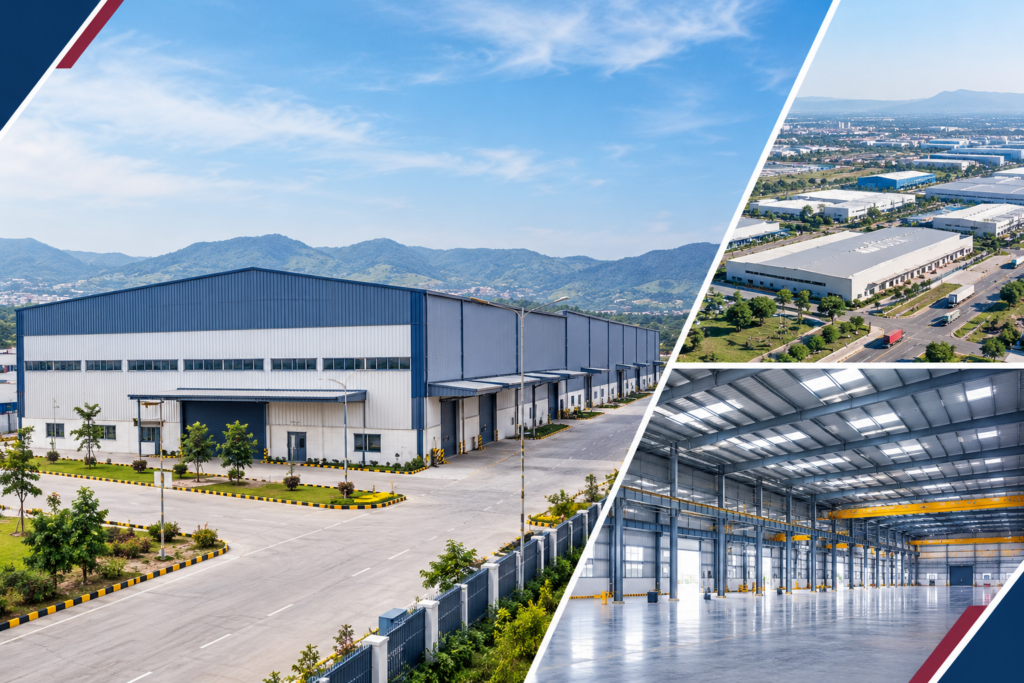
Pune industrial area searches are important for manufacturers, entrepreneurs, warehouse operators, and businesses planning to establish or expand their industrial facilities in Maharashtra. With established manufacturing clusters, engineering industries, automotive businesses, and industrial development zones, Pune offers several locations for businesses evaluating their next investment. Understanding the major industrial areas in Pune, their connectivity, infrastructure, and site requirements can help businesses make informed decisions before investing in factory construction, industrial sheds, or pre-engineered building (PEB) structures.
However, selecting an industrial location involves more than finding available land. Businesses must consider transportation, workforce availability, utilities, regulatory requirements, operational needs, and the type of building their activities require.
In this guide, we explore major industrial hubs in and around Pune, explain the factors businesses should evaluate when selecting a location, and discuss important considerations for planning an industrial building.
Why Is Pune an Important Industrial Destination?
Pune has developed into an important industrial and manufacturing centre in Maharashtra. Its industrial ecosystem includes automotive manufacturing, engineering, industrial equipment, manufacturing components, logistics, warehousing, and supporting businesses.
The wider Pune region includes established industrial areas and manufacturing clusters with different characteristics. These locations can serve businesses with different operational requirements, depending on their industry, supply chain, workforce needs, and investment plans.
For businesses considering a Pune industrial area, the main advantages to evaluate include:
- Access to manufacturing suppliers and industrial service providers.
- Connectivity to regional transport networks.
- Availability of industrial infrastructure in established clusters.
- Access to skilled and semi-skilled workers.
- Opportunities to serve customers and business partners across Maharashtra.
- Potential to establish facilities suited to manufacturing, storage, fabrication, and distribution.
The suitability of any particular location depends on the proposed business activity, the specific site, and the infrastructure available. Businesses should verify current conditions before making a purchase or lease commitment.
Major Industrial Areas in Pune
Several industrial locations in and around Pune attract manufacturing businesses, engineering companies, suppliers, and warehouse operators.
The following overview introduces key areas businesses may consider when researching a Pune industrial area.
1. Chakan Industrial Area
Chakan is one of the prominent manufacturing hubs in the Pune region. It is particularly associated with automotive manufacturing, engineering, component production, and supporting industrial businesses.
Its industrial ecosystem makes it a location worth evaluating for companies that need to work closely with manufacturing suppliers, production facilities, and industrial customers.
What businesses should consider in Chakan:
- Proximity to suppliers, customers, and business partners.
- Access routes for commercial vehicles and goods transportation.
- Availability and suitability of industrial plots or premises.
- Electricity, water, drainage, and other utility requirements.
- Space for manufacturing operations, storage, and future expansion.
Companies planning to establish a new facility should evaluate the specific industrial estate and plot rather than relying only on the area’s overall reputation.
For businesses planning a new factory, industrial shed, or PEB building, the proposed layout should accommodate machinery, material movement, loading areas, and production workflows.
2. Pimpri-Chinchwad Industrial Belt
Pimpri-Chinchwad is an established industrial region associated with manufacturing, automotive businesses, engineering, and industrial suppliers.
Its developed urban and industrial environment may be relevant to businesses that value proximity to existing industrial networks and established commercial services.
When evaluating this industrial belt, businesses should assess the suitability of individual premises, road access, operational restrictions, and available space.
Important considerations include:
- Access for employees and industrial transportation.
- Distance from suppliers and customers.
- Existing building condition and usable floor area.
- Loading, unloading, and internal circulation requirements.
- Applicable permissions and restrictions for the intended activity.
For companies considering an existing factory building or a new industrial structure, the available plot area and operational requirements should guide the final decision.
3. Talegaon Industrial Area
Talegaon is another industrial location in the Pune region that businesses may consider when evaluating manufacturing facilities, industrial buildings, and logistics operations.
Its suitability depends on the particular site’s connectivity, available infrastructure, workforce access, and relationship to the company’s supply chain.
Businesses comparing Talegaon with other industrial locations should examine the full operating cost rather than focusing exclusively on land or rental prices.
Before selecting a site in Talegaon, evaluate:
- Travel time for employees and transport vehicles.
- Access to suppliers and customer locations.
- Availability of suitable industrial premises or land.
- Utility capacity and site-development requirements.
- Space for production, warehousing, and future expansion.
If the business requires a new factory or industrial shed, the location assessment should be completed alongside preliminary building planning.
4. Ranjangaon Industrial Area
Ranjangaon is a recognised industrial location in the wider Pune region and is associated with manufacturing and industrial investment.
It may be worth evaluating for companies seeking an industrial location that fits their production requirements, logistics strategy, and long-term operating plans.
Businesses should confirm the specific site’s industrial classification, available infrastructure, applicable development conditions, and access to the transport routes relevant to their operations.
Key factors to review include:
- Proximity to suppliers, customers, and distribution networks.
- Suitability of the plot for the intended industrial activity.
- Availability of power, water, drainage, and other essential utilities.
- Space for production equipment, storage, and vehicle movement.
- Scope for future capacity expansion.
For businesses planning a new industrial facility, early coordination between site selection, structural design, and operational planning can help reduce avoidable changes later.
5. Baramati Industrial Region
Baramati is another location in the broader Pune district that businesses may evaluate for industrial and manufacturing activities.
Its suitability depends on the business sector, the location of suppliers and customers, transportation requirements, and the availability of appropriate industrial infrastructure.
Businesses considering Baramati should verify the status and facilities of the specific industrial estate or site under consideration.
Questions to consider include:
- Does the location suit the company’s supply chain?
- Are essential utilities available at the site?
- Is the site appropriate for the proposed manufacturing process?
- Can goods and raw materials be transported efficiently?
- Is there sufficient space for the required building and future expansion?
The right industrial location is the one that supports the business’s operational requirements and long-term plans, not necessarily the one with the lowest initial land cost.
How to Compare Industrial Areas in Pune
Choosing between different industrial areas in Pune requires a structured evaluation of business priorities.
A location suitable for an automotive component manufacturer may not be the best choice for a distribution warehouse or a fabrication facility.
Use the following comparison framework when shortlisting locations.
| Evaluation Factor | What Businesses Should Check |
| Connectivity | Road access, freight movement, travel times, and proximity to important transport routes. |
| Industrial ecosystem | Availability of relevant suppliers, customers, maintenance providers, and supporting industries. |
| Workforce | Access to employees with the skills required for the business. |
| Utilities | Electricity capacity, water availability, drainage, and other essential services. |
| Site suitability | Plot dimensions, access, ground conditions, and permitted industrial use. |
| Construction requirements | Feasibility of the required factory, warehouse, industrial shed, or PEB structure. |
| Operating costs | Land or rent, utilities, transportation, maintenance, and other recurring expenses. |
| Expansion potential | Whether the location and building can accommodate future operational needs. |
| Compliance | Applicable development permissions, environmental requirements, fire safety provisions, and other regulations. |
The comparison should be based on the company’s actual operating requirements and verified information for each shortlisted site.
Industrial Infrastructure in Pune: What Should Businesses Evaluate?
Industrial infrastructure directly affects how a facility operates after construction.
Before committing to a location, businesses should assess whether the site can support their production activities, workforce, equipment, and transportation needs.
1. Road Connectivity and Transportation
Road access affects the movement of raw materials, finished products, machinery, and employees.
Businesses should assess the actual route used by commercial vehicles, including access restrictions, congestion, turning space, and the distance to key suppliers or customers.
For factories and warehouses, site access should also accommodate loading and unloading activities without disrupting internal operations.
2. Electricity and Utility Availability
Manufacturing processes can require substantial electrical capacity, compressed air, water, drainage, or other utilities.
Businesses should identify their expected consumption and verify availability with the relevant authorities or service providers before finalising a site.
A building’s structural design and internal layout should account for the installation, maintenance, and safe operation of the required equipment.
3. Workforce and Supporting Services
Workforce availability can influence production schedules, operating costs, and recruitment plans.
Businesses should consider employee commuting options and the availability of nearby industrial support services, including equipment maintenance, fabrication, and material suppliers.
The importance of these factors varies by industry and operating model.
4. Permissions and Site Compliance
Before purchasing or leasing an industrial property, businesses should confirm that the intended activity is permitted at the selected location.
Depending on the project, requirements may include land-use permissions, building approvals, fire safety provisions, environmental clearances, and other statutory approvals.
The exact requirements depend on the site’s location, industrial activity, project scope, and applicable regulations. Businesses should consult the relevant authorities and qualified professionals before proceeding.
Factory Planning in Pune: What Should You Consider Before Construction?
After shortlisting an industrial area, the next step is to assess the building requirements.
Good factory planning connects the site, production process, building layout, utilities, and future expansion requirements.
1. Define Your Operational Requirements
Start by documenting what the facility needs to accommodate.
Consider:
- Production machinery and equipment.
- Raw material storage.
- Finished goods storage.
- Assembly and manufacturing areas.
- Loading and unloading zones.
- Employee facilities and office space.
- Internal vehicle and material movement.
- Future production capacity.
A clear requirement list helps the project team develop a building layout suited to the business rather than forcing operations into an unsuitable structure.
2. Choose the Right Industrial Building Type
The appropriate building depends on the activity, site conditions, structural requirements, budget, and future plans.
Common considerations include conventional steel structures, pre-engineered buildings, industrial sheds, and specialised industrial buildings.
For example, a facility requiring large unobstructed working areas may have different structural needs from a building designed primarily for storage or equipment housing.
The final solution should be determined through an assessment of the project requirements and an appropriate engineering design.
3. Plan for Machinery and Material Movement
Factory layouts should account for the movement of materials throughout the production process.
The arrangement of machinery, storage areas, access routes, and loading zones can influence productivity and safety.
Where applicable, consider equipment foundations, overhead crane requirements, ventilation, maintenance clearances, and access for installation or replacement of machinery.
These requirements should be identified early so they can be incorporated into the building design.
4. Consider Future Expansion
Businesses may need additional machinery, storage, production capacity, or supporting facilities as operations grow.
Planning for possible expansion at the beginning can help avoid unnecessary structural changes and operational disruptions later.
Consider whether the plot layout, building configuration, utilities, and access routes can accommodate realistic future requirements.
Any proposed expansion should remain subject to engineering feasibility and applicable permissions.
Industrial Shed Construction in Pune’s Industrial Areas
Industrial sheds are used for a range of applications, including manufacturing, fabrication, storage, workshops, and industrial support operations.
For businesses planning industrial shed construction in Pune, the design should reflect the site’s conditions and the facility’s intended use.
Important planning considerations include:
- Building dimensions and clear-span requirements.
- Structural design loads and applicable engineering standards.
- Roofing and wall cladding specifications.
- Foundation design based on site conditions.
- Ventilation, daylighting, and thermal considerations.
- Flooring requirements based on machinery and operational loads.
- Drainage and rainwater management.
- Fire safety and access provisions.
- Electrical, plumbing, and other utility requirements.
- Provision for equipment installation and future expansion.
The required specifications vary by project. A suitable industrial shed should be designed around the actual operational, structural, and compliance requirements rather than selected on price alone.
How to Select an Industrial Shed Manufacturer in Pune
When evaluating industrial shed manufacturers in Pune, businesses should look beyond the initial quotation.
Review the proposed scope, design responsibility, material specifications, fabrication quality, erection arrangements, project timeline, and relevant experience.
Ask potential contractors to clarify which activities are included and which are excluded from the quotation.
For example, structural fabrication, transportation, erection, civil foundations, flooring, utilities, and finishing work may be covered under different scopes depending on the contractor and agreement.
A detailed scope comparison makes it easier to evaluate proposals fairly and understand the total project commitment.
PEB Structures in Pune: An Option for Industrial Buildings
Pre-engineered buildings (PEBs) are steel building systems designed and manufactured to meet project-specific requirements.
They are used in applications such as industrial sheds, manufacturing facilities, warehouses, and other buildings where their structural characteristics suit the intended use.
Businesses considering PEB structures in Pune should evaluate the building’s dimensions, structural loads, site conditions, operational requirements, and installation scope.
When Should Businesses Consider a PEB Structure?
A PEB system may be worth evaluating when a project requires:
- A building designed around specific industrial dimensions.
- Efficient coordination between engineering and fabrication.
- A roof and wall system suited to the intended activity.
- Provision for machinery or material handling equipment.
- A building layout that supports the required operational workflow.
- A planned construction and installation sequence.
Whether a PEB system is suitable depends on the project. Compare the complete design, specifications, costs, and scope with other appropriate construction options before making a decision.
What Should a PEB Structure Quotation Include?
When requesting a quotation from PEB structure manufacturers or contractors, provide as much project information as possible.
A useful enquiry should specify:
- Project location.
- Approximate building length, width, and height.
- Intended building use.
- Clear-span and internal-column requirements.
- Crane or machinery requirements, where applicable.
- Roofing and cladding preferences.
- Known site and foundation information.
- Required delivery and installation scope.
- Expected project schedule.
The supplier should clarify the design basis, material specifications, inclusions, exclusions, and responsibilities for approvals and installation.
Accurate project information makes it easier to prepare a relevant proposal and reduces the likelihood of significant changes later.
How Jyotirling Group Can Support Industrial Construction Planning
Businesses planning industrial facilities in Pune may need to coordinate building design, structural requirements, fabrication, and project execution.
Jyotirling Group provides services related to industrial sheds, pre-engineered buildings, and turnkey industrial projects.
When evaluating an industrial construction partner, businesses should discuss their operational needs, proposed location, building dimensions, site constraints, and project scope at the beginning of the process.
A project discussion can help establish the information required to assess feasibility and prepare a suitable proposal.
If you are planning a new factory, warehouse, or industrial shed, explore Jyotirling Group’s services and contact the team to discuss your project requirements.
Planning an industrial shed or PEB structure in Pune? Share your project location, building requirements, and intended use with Jyotirling Group to begin a project-specific discussion.
Frequently Asked Questions About Pune Industrial Areas
1. Which are the major industrial areas in Pune?
Major industrial locations in and around Pune include Chakan, Pimpri-Chinchwad, Talegaon, and Ranjangaon. Baramati is another location in the broader Pune district that businesses may consider. The suitability of each area depends on the specific site, industrial activity, connectivity, and infrastructure requirements.
2. Which industrial area in Pune is best for setting up a factory?
There is no single best industrial area for every factory. Businesses should compare locations based on supplier and customer access, transportation, workforce availability, utilities, permitted land use, site suitability, and operating costs. The best choice is the location that fits the company’s specific production and logistics requirements.
3. Is Chakan a suitable location for manufacturing businesses?
Chakan is an established manufacturing hub in the Pune region, particularly associated with automotive, engineering, and supporting industries. Businesses should assess the particular site, utility availability, transportation routes, workforce requirements, and applicable permissions before deciding whether it suits their operations.
4. What should businesses check before selecting an industrial plot in Pune?
Businesses should verify the permitted land use, plot dimensions, access routes, ground conditions, electricity and water availability, drainage, development restrictions, and relevant statutory approvals. They should also confirm that the site can accommodate the proposed building and operational requirements.
5. What factors affect industrial shed construction costs in Pune?
Industrial shed construction costs depend on building dimensions, structural design, steel quantities, roofing and cladding, foundations, soil conditions, flooring, utilities, transportation, erection work, and the agreed project scope. A reliable estimate requires project-specific information and an appropriate design basis.
6. What is the difference between an industrial shed and a PEB structure?
An industrial shed describes a building intended for industrial activities such as manufacturing, storage, or fabrication. A PEB refers to a pre-engineered building system designed and manufactured around specified requirements. A PEB system can be used to construct an industrial shed when it is appropriate for the project.
7. How do I choose an industrial shed manufacturer in Pune?
Compare relevant project experience, engineering and design capabilities, material specifications, fabrication quality, installation arrangements, project timelines, and quotation details. Ask for a clear breakdown of inclusions and exclusions so that you can compare proposals on a consistent basis.
8. What information is needed to request a PEB structure quotation?
Provide the project location, approximate building dimensions, intended use, clear-span requirements, machinery or crane requirements, roofing and cladding preferences, site information, and expected project scope. The supplier may need additional engineering details before preparing a final quotation.
9. Can an industrial building be designed for future expansion?
Yes, future expansion can be considered during initial planning. The feasibility depends on the plot, structural design, building configuration, utilities, and applicable permissions. Potential expansion requirements should be discussed with the design and engineering team before construction begins.
10. How can Jyotirling Group help with industrial shed or PEB projects?
Jyotirling Group offers industrial shed, PEB structure, and turnkey industrial project services. Businesses can discuss their project requirements with the team to understand the relevant services, project scope, and information needed for a proposal.
Conclusion
Choosing the right Pune industrial area is an important step for businesses planning a new factory, warehouse, or manufacturing facility. Locations such as Chakan, Pimpri-Chinchwad, Talegaon, and Ranjangaon offer different industrial settings, but the right choice depends on the company’s operational needs, infrastructure requirements, and long-term plans.
Before committing to a site, evaluate connectivity, utilities, workforce availability, permitted land use, operating costs, and expansion potential. Then align the building design with the production process, machinery, storage requirements, and project budget.
For businesses planning industrial shed construction or a PEB structure in Pune, early coordination between site selection and building planning can support better project decisions.
Jyotirling Group can discuss industrial shed, PEB structure, and turnkey industrial project requirements with businesses planning their next industrial facility.