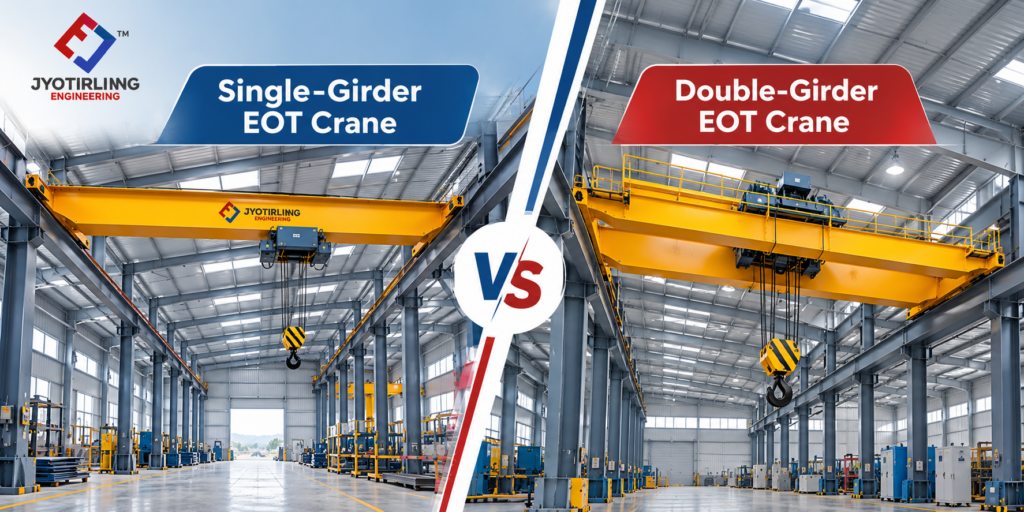
Choosing between single-girder vs double-girder EOT cranes affects more than your lifting equipment budget. The selected crane’s dimensions, wheel loads, operating duty and required clearances influence the design of your PEB shed, including runway beams, supporting columns and foundations.
For manufacturers planning a factory or workshop, crane selection should happen alongside building design. Choosing the crane after finalising the shed can create avoidable clearance problems, structural changes and additional costs.
This guide explains the differences and how to compare both options before approving your crane-compatible PEB shed design.
Single-Girder vs Double-Girder EOT Cranes: What Is the Difference?
An Electric Overhead Travelling—or EOT—crane moves loads vertically and horizontally within its working area.
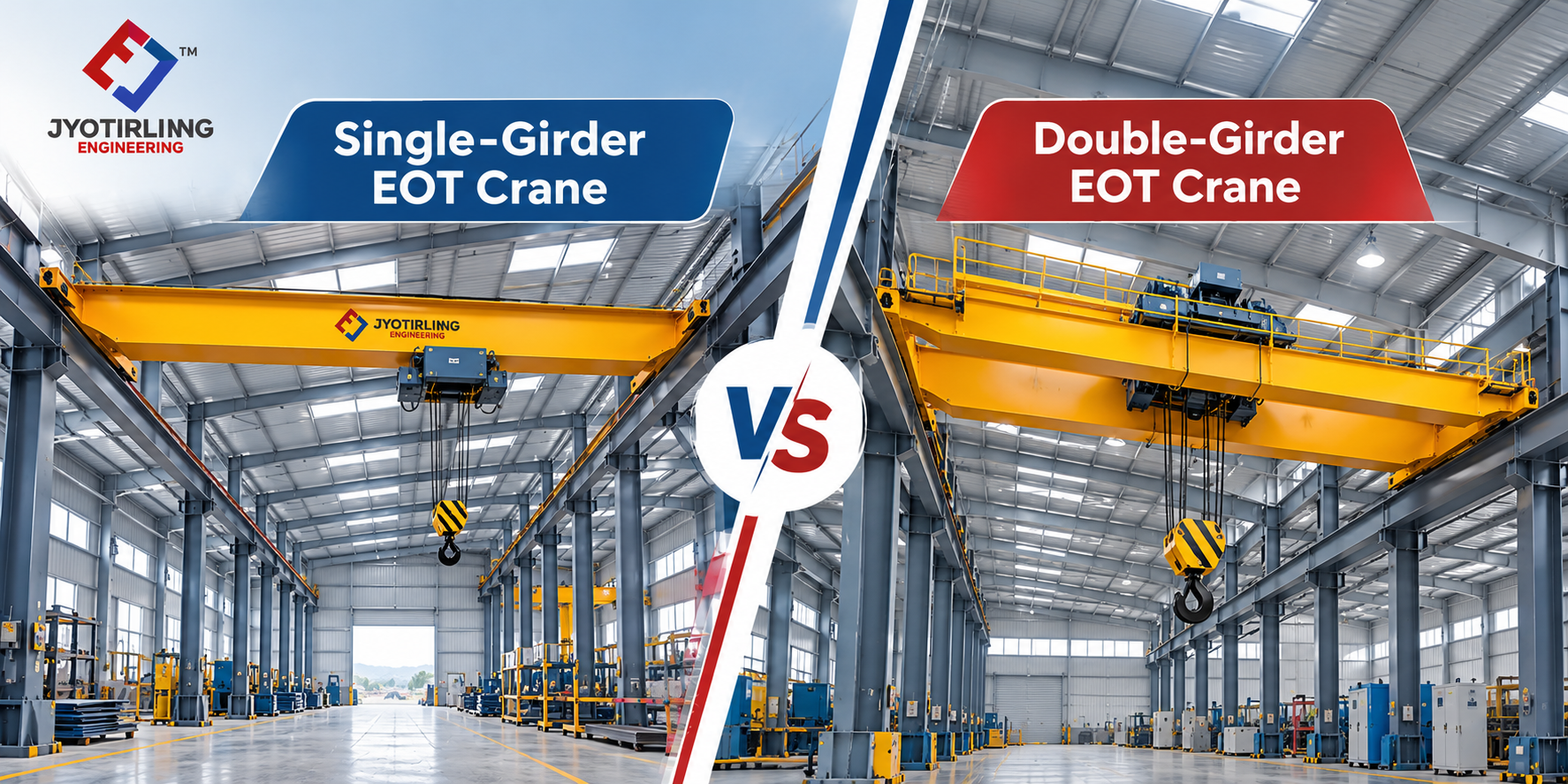
A single-girder EOT crane has one main bridge girder. In a common arrangement, the hoist travels beneath that girder.
A double-girder EOT crane has two main bridge girders. A common configuration uses a trolley travelling above them, allowing the hook to rise between the girders.
These are typical arrangements, not universal specifications. The supplier’s drawings determine the actual geometry and building requirements.
| Comparison Factor | Single-Girder EOT Crane | Double-Girder EOT Crane |
| Main bridge arrangement | One girder | Two girders |
| Typical hoist arrangement | Hoist beneath the girder | Trolley above the girders |
| Selection considerations | Capacity, span, duty and available space | Capacity, span, duty, hook height and operational features |
| Building loads | Confirm supplier-specific wheel reactions | Confirm supplier-specific wheel reactions |
| Lifting geometry | Depends on hoist and bridge configuration | May offer a higher hook position relative to the runway |
| Cost comparison | Assess complete installed scope | Assess complete installed scope |
Neither crane type is automatically the best choice. Compare models that meet the same lifting task and operating requirements.
How Crane Selection Affects PEB Shed Height
Single-Girder EOT Cranes: Check Hoist Headroom
In a typical single-girder arrangement, the hoist beneath the bridge occupies space above the highest hook position.
Low-headroom configurations can improve space utilisation, but their dimensions vary. Confirm the required hook height and the supplier’s headroom dimensions before fixing the runway elevation.
Double-Girder EOT Cranes: Check Space Above the Runway
Some double-girder designs provide a high lifting position because the hook can rise between the bridge girders. Demag identifies this feature in its ZKKE double-girder range. Demag
However, the trolley and bridge still need clearance above the runway. A higher hook position does not automatically mean a lower overall shed.
Compare the complete vertical arrangement:
- Finished floor level.
- Required highest hook position.
- Runway rail elevation.
- Top of the crane and trolley.
- Lowest roof member or building obstruction.
- Required operating and maintenance clearances.
The final building height should follow these dimensions rather than a general assumption about girder type.
How Single-Girder vs Double-Girder EOT Cranes Affect Structural Loads
Crane Self-Weight and Wheel Reactions
The supporting structure carries loads from the crane and its lifted load.
Certain single-girder designs use low self-weight to reduce runway loading. For example, Demag describes this benefit for its EKKE range. That is a model-specific advantage, not proof that every single-girder crane produces lower wheel loads than every double-girder crane. Demag
Wheel reactions also depend on wheel arrangement, span and trolley position.
Request confirmed supplier data rather than estimating building loads from lifting capacity alone.
Operating Forces and Duty Classification
Crane movement introduces actions beyond static vertical loading. The structural engineer must establish the applicable dynamic, transverse and longitudinal actions and load combinations.
Operating frequency matters too. Crane usage classification considers load, operating frequency and expected service life. craneadvisor.konecranes.com
A crane used for occasional equipment maintenance has different demands from one serving continuous production. Girder count alone does not define suitability for either task.
What Changes in Crane-Compatible PEB Shed Design?
Crane Runway Beams and Connections
Runway beams support the rails along which the crane travels.
Their design depends on supplier loads, support spacing and the applicable strength and serviceability requirements. Connections, brackets and bracing also need coordinated design.
Switching crane models can change these requirements even when rated lifting capacity remains unchanged.
PEB Columns and Support Arrangement
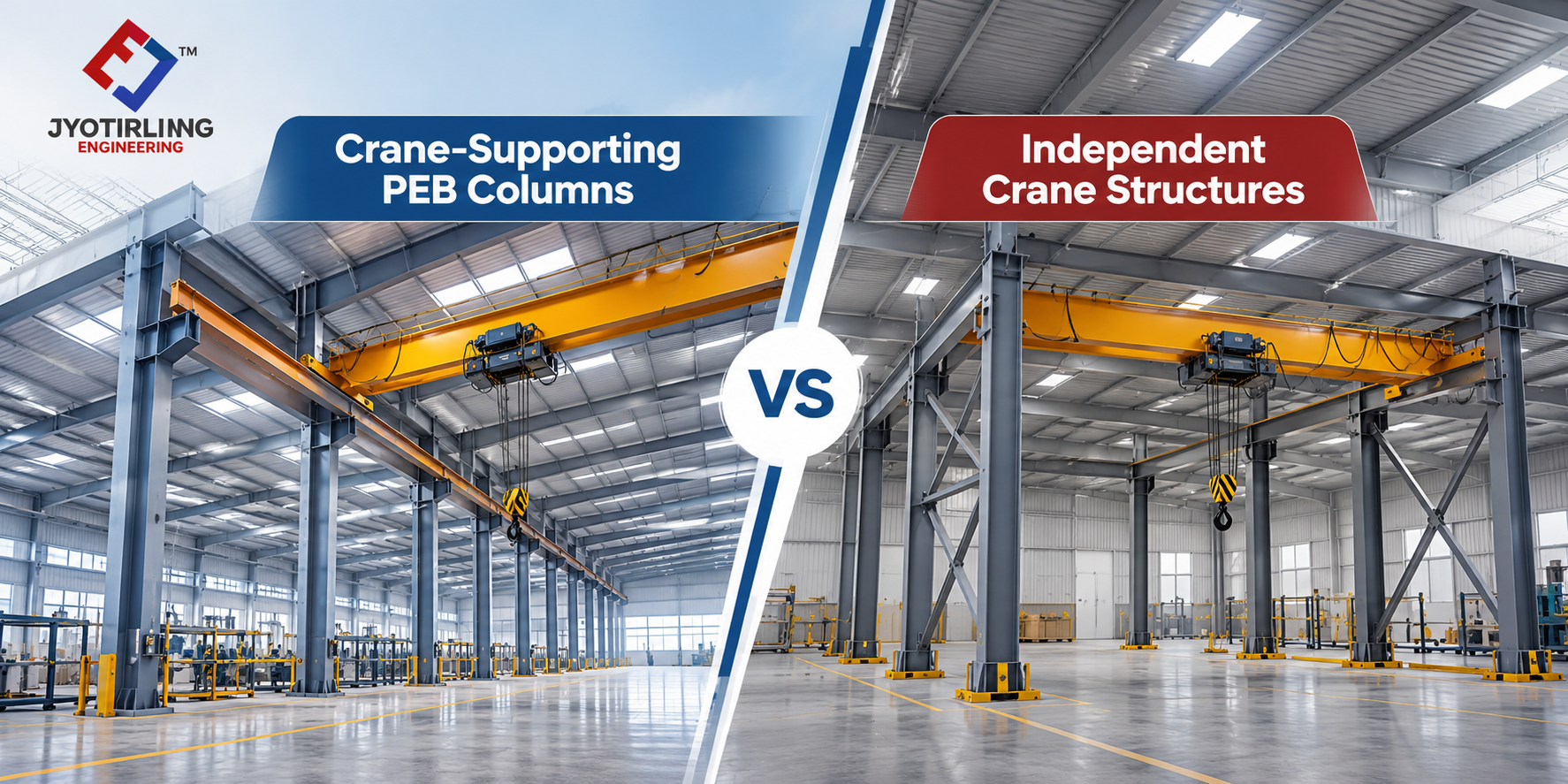
Crane runway beams may be supported by the building columns or by an independent crane structure.
Where building columns carry crane loads, those loads must be included in the PEB frame design. A separate supporting structure needs its own engineered stability, anchorage and foundation arrangement.
The choice between integrated and independent support should consider layout and structural requirements alongside cost.
Foundations and Ground Conditions
Different crane configurations can produce different support reactions. These reactions, together with building loads and soil conditions, influence foundation design.
A double-girder crane does not automatically require a particular foundation size. Likewise, a single-girder crane does not guarantee that standard shed foundations will be sufficient.
Obtain a coordinated foundation design based on actual loads.
How Crane Span and Hook Approach Affect Factory Layout
Crane span is usually measured between runway rail centre lines. It should not be confused with the overall building width.
Also check the hook’s approach distances near side walls and runway ends. These determine how closely the crane can serve machinery, storage or loading positions.
Before approving the layout, identify:
- Maximum load dimensions and weight.
- Pickup and placement locations.
- Machinery requiring overhead handling.
- Loading and unloading areas.
- Routes where suspended loads will travel.
- Obstructions from columns, services or equipment.
The right EOT crane for a PEB shed must reach the required work areas, not merely fit inside the building.
Single-Girder vs Double-Girder EOT Crane Cost: Compare the Whole Project
A crane equipment quotation represents only part of the investment.
Compare:
Total installed cost = crane equipment + supporting structure + foundations + electrical supply + installation + testing and commissioning
Single-Girder EOT Crane Cost Considerations
A suitable single-girder configuration may offer an economical solution for the required task. However, assess whether its lifting geometry, span and duty meet your needs.
A lower equipment price provides limited value if it requires changes to shed height or cannot serve critical work areas.
Double-Girder EOT Crane Cost Considerations
A double-girder configuration may justify additional expenditure where its lifting geometry, capacity, span or available operational features better match production requirements.
The proposal should demonstrate the benefit for your application rather than relying on a general claim that two girders are always superior.
PEB Shed Construction Cost Considerations
For each proposed crane, ask the building contractor to assess:
- Structural steel and runway requirements.
- Building height and cladding implications.
- Foundation requirements.
- Access and maintenance provisions.
- Erection and coordination costs.
- Future upgrade assumptions.
Avoid comparing generic prices per square foot without matching these specifications.
Which Crane Type Suits Your Factory?
Evaluate a single-girder crane when a supplier can meet your capacity, span, duty and coverage requirements with an efficient configuration.
Evaluate a double-girder crane when the task calls for lifting geometry, capacity, span or features better served by a suitable double-girder model.
For an existing PEB shed, assess available headroom and structural capacity before choosing either option.
There is no universal lifting-capacity threshold that determines girder selection across all suppliers. Product ranges overlap, and the final choice should follow application-specific engineering.
What to Check Before Requesting Quotations
Give the crane supplier and PEB contractor the same project brief:
- Rated load, including applicable lifting attachments.
- Typical loads and lifting frequency.
- Required span, travel length and hook height.
- Number of cranes operating on each runway.
- Crane speeds and control requirements.
- Factory environment and exposure conditions.
- Building layout and machinery positions.
- Future expansion requirements.
Then obtain the crane general arrangement drawing, wheel loads and clearance information. Crane planning resources provide these inputs specifically for coordination with building design. gateway-portal.konecranes.com
Clearly assign responsibility for rails, alignment, electrical supply, civil work and commissioning.
FAQs About Single-Girder vs Double-Girder EOT Cranes
Which is better for a PEB shed: a single-girder or double-girder EOT crane?
The better option is the one that meets your lifting task, operating duty, clearances and structural requirements at an acceptable total cost. Building and crane designs should be assessed together.
Does a double-girder crane always need a taller shed?
No. Its trolley and bridge require overhead clearance, but some configurations offer a higher hook position relative to the runway. Compare supplier drawings to establish the required shed height.
Is a single-girder EOT crane always cheaper?
No. It may offer a lower initial equipment cost for some applications, but the complete comparison must include supporting steelwork, foundations, electrical work and installation.
Can two cranes with the same capacity require different PEB designs?
Yes. Their self-weight, wheel spacing, wheel reactions, dimensions and operating requirements may differ despite having the same rated capacity.
Can an existing PEB shed accommodate a double-girder crane?
Possibly, subject to assessment of the structure, foundations, headroom and proposed crane loads. Strengthening or independent support may be required.
Can a single-girder crane be replaced with a double-girder crane later?
Potentially, but the runway, supports, foundations, clearances and electrical systems must be reviewed. Matching lifting capacity does not establish compatibility.
Plan Your Crane and PEB Shed Together
The single-girder vs double-girder EOT cranes decision should follow your production requirements and the complete building design. Confirm crane data early to make quotations clearer and reduce the likelihood of redesign.
Planning a crane-compatible factory or industrial shed? Contact Jyotirling Engineering to discuss your PEB structure requirements and project scope.
📞 +91 8989909797
🌐 www.jyotirlinggroup.com